5 Hidden Features of the Asus Rog Nuc 2025 You Must Know About
Introduction
The Asus ROG NUC 2025 positions itself as a compelling choice for buyers who need desktop-class performance in a tiny chassis. On the surface it looks like another powerful mini PC for gamers and creators, but beneath the exterior are several lesser-known capabilities that materially affect usability, upgradeability, and long-term value. This article highlights five hidden features that matter to real-world buyers — what they do, how to access them, and why they change the purchase calculus for gamers, content creators, home-theater enthusiasts, and professionals who need a compact workstation.
Detailed product review and analysis
The ROG NUC line blends Intel platform advancements, discrete GPU options, and Asus firmware/software polish. The 2025 model continues that trend with a compact footprint, robust I/O, and software integration through Armoury Crate and GameFirst. What separates a good mini PC from a standout one is often not just the headline specs but the engineering and software features that unlock consistent performance and practical expandability in daily use. The five hidden features described below are those practical differences: performance tuning at firmware level, flexible storage options, high-bandwidth Thunderbolt connectivity, display switching for low-latency gaming, and advanced cooling/noise controls. Each section explains how to find and use the feature and gives concrete scenarios where it delivers value.
1. Firmware and Armoury Crate: granular performance modes beyond presets
Most buyers notice the standard performance modes (Silent, Balanced, Turbo) available in software, but the ROG NUC 2025 exposes much deeper controls through the BIOS and Asus's Armoury Crate suite. Beyond simple presets, users can adjust:
- CPU power limits (PL1/PL2) and sustained TDP targets to tune thermal headroom.
- GPU power budgets when discrete GPUs are present, enabling a balance between peak frame rates and chassis heat.
- Fan curves with multi-point control (RPM vs temperature) and different ramp profiles for CPU and GPU zones.
- P-state and E-core/P-core selection (on hybrid architectures), allowing workloads to be pinned to the fastest cores or the efficiency cores depending on the need.
Real-world use case: a streamer who records 1080p/60 gameplay can cap sustained CPU power to keep noise down during long sessions, while still allowing short PL2 boosts for quick encoding peaks. A content creator exporting video can push the sustained TDP higher for consistent throughput without thermal throttling. Because these options live in both the BIOS and Armoury Crate, changes can be tested quickly and reverted without reinstalling drivers.
2. Dual NVMe flexibility and an underrated service-friendly layout
Compact systems often sacrifice expandability, but the ROG NUC 2025 hides a practical upgrade path. Inside the bottom-access panel are two M.2 slots (one usually accessible without removing the whole motherboard), SODIMM RAM slots, and sometimes an easily-reachable Wi‑Fi card. The layout is designed so upgrades do not require a full teardown.
Key benefits:
Discover deals on Laptops & Computers — updated daily.
View Offers →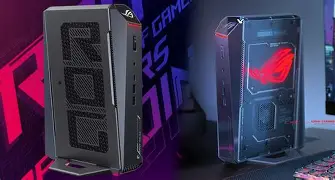
- Install a high-performance NVMe for the OS and a second NVMe for scratch or games without external cages.
- Use the second M.2 for a dedicated capture drive or to experiment with different OS images for testing.
- Swap SODIMM modules to double RAM for memory-heavy workloads (video editing, VMs) without special tools.
Real-world use case: a creative professional who moves large footage between projects can keep a fast working NVMe for active projects and a secondary NVMe for archived material. Gamers who manage many large titles can put frequently played games on the primary drive and less-played libraries on the secondary.
3. Thunderbolt 4 / USB4: external GPU and high-speed docking that actually works
Thunderbolt 4 (USB4) is often treated as a convenience for external docks and fast storage, but on the ROG NUC 2025 it unlocks high-bandwidth workflows that mini PCs otherwise struggle to handle. The port supports:
- eGPU enclosures for users who want desktop GPU power occasionally but prefer a small form factor most of the time.
- High-resolution multi-monitor chains (two 4K60 displays or a single 8K display in supported scenarios), simplifying a portable multi-monitor workstation setup.
- Direct PCIe tunneling for specialized devices like capture cards, NVMe-over-TB enclosures, and FPGA accelerator modules.
Real-world use case: a photographer who travels with a NUC can dock to a Thunderbolt dock at home and reattach to a lightweight USB-C monitor setup on the road. For video editors, plugging into an eGPU during rendering sessions is a quick way to scale performance without maintaining two separate full-size desktops.
4. Low-latency display switching and hybrid GPU behavior
High-end compact PCs sometimes hide a configuration that toggles how the integrated and discrete GPUs are used. Whether implemented as a hardware MUX switch or exposed in the firmware/software stack, the ROG NUC 2025 offers a hidden option to favor:
- Minimum display latency by routing the panel output through the discrete GPU (best for competitive gaming).
- Battery life and integrated graphics efficiency by keeping the display on the iGPU and using the dGPU for rendering only (if using battery or low-power modes).
Why it matters: many buyers assume the system always chooses the right path, but manually switching can reduce input lag by several milliseconds for competitive play or extend thermal headroom and battery life for everyday tasks. The toggle is commonly buried in advanced graphics settings or in Armoury Crate’s performance sections.
Real-world use case: an esports competitor can enable the low-latency path for tournament play, then switch back to the efficiency mode for streaming, where sustained thermal control and quieter fans are more valuable than a handful of milliseconds.
Find top-rated Laptops & Computers products at great prices.
Browse Now →5. Tunable cooling and a discreet "quiet mode" that preserves performance
Cooling in tiny chassis is a balancing act. Beyond a single "quiet" profile, Asus equips this NUC with a multi-dimensional thermal strategy combining heat-pipe or vapor-chamber cooling, targeted exhaust routing, and tunable firmware controls. Hidden in the software and BIOS are features such as:
- Separate fan curves for CPU and GPU with user-set temperature thresholds and hysteresis to avoid rapid spin fluctuations.
- Short-duration boost windows that allow brief high-power operation followed by sustained lower-power to limit noise while preserving frame rates in bursts.
- Per-port thermal throttling for hot peripherals (e.g., high-power NVMe enclosures), preventing one device from forcing system-wide throttle.
Real-world use case: someone using the NUC as a living-room PC for both gaming and media playback can create a custom "movie" profile that keeps fans at near-silent levels while ensuring the onboard GPU can still decode 4K HEVC streams without stutter. A developer running background compiles can configure a longer, lower-power window so builds complete in an acceptable time while the system remains unobtrusive at the desk.
Pros & Cons
- Pros:
- Compact footprint with desktop-class performance options.
- Firmware and software expose powerful tuning knobs for advanced users.
- Thunderbolt 4 delivers genuine expandability for docks and eGPUs.
- Service-friendly layout makes upgrades and repairs accessible.
- Multiple thermal profiles allow adaptive behavior for different use cases.
- Cons:
- Compact size still limits absolute thermal headroom compared with full-size towers.
- Advanced options require a willingness to learn BIOS and Armoury Crate controls.
- Fewer internal expansion bays — no full-size 3.5" HDD without external enclosures.
- Some hidden features are buried in menus, making them easy to miss for casual buyers.
Quick comparison: ROG NUC 2025 vs. typical small form-factor alternatives
| Feature | ROG NUC 2025 | Standard Mini-PC | Small Form-Factor Gaming Desktop |
|---|---|---|---|
| Size | Very compact (palm-sized) | Compact but often thicker | Larger; fits mini-ITX cases |
| GPU Options | Discrete mobile/desktop-class options, TB4 for eGPU | Often integrated or low-power dGPU | Full-size GPUs supported |
| Storage Expandability | Dual NVMe + SODIMM RAM accessible | Single NVMe + limited upgrades | Multiple NVMe + SATA bays |
| Ports & I/O | Thunderbolt 4, multiple USB-A/C, Ethernet | Limited USB-C, fewer high-bandwidth ports | Plenty of ports, PCIe slots for add-in cards |
| Noise & Cooling | Tunable fan curves, engineered airflow | Conservative cooling to favor silence | More headroom, but louder under load |
| Upgradeability | Good for its size; user-accessible internals | Limited; sometimes soldered components | Best upgrade path overall |
Buying guide: what to prioritize for different buyers
Choosing the right configuration of the ROG NUC 2025 depends on how the buyer intends to use it. The following checklist helps clarify priorities and trade-offs.
For gamers
- Prioritize the discrete GPU variant or ensure a Thunderbolt 4 port for future eGPU use.
- Check for the low-latency display switching option if competitive play is important.
- Look for units with higher sustained TDP settings and confirm good cooling reviews to avoid thermal throttling during long sessions.
- Invest in a fast NVMe for game installs and a secondary drive if managing very large libraries.
For content creators and prosumers
- Max out RAM and choose the largest NVMe you can afford; editing and rendering benefit from both.
- Use Thunderbolt 4 docks for external storage arrays or capture devices; ensure TB4 is implemented with full PCIe lanes.
- Enable sustained performance BIOS profiles for long renders and verify that fan curves can be tuned for longer high-load periods.
For home theater and HTPC use
- Choose a quiet configuration or create a custom “movie” profile to keep fans near-silent while decoding 4K content.
- Confirm full-size HDMI/DisplayPort audio pass-through is present if AVR compatibility is required.
- Prioritize network connectivity (2.5GbE or strong Wi‑Fi) for streaming high-bitrate media.
For office and productivity users
- Use the NUC as a dockable workstation by leveraging Thunderbolt docking to connect displays and peripherals at a desk and a lightweight configuration on the go.
- If virtualization or many browser tabs are the norm, favor higher RAM configurations and larger NVMe drives.
- Consider warranty and thermal throttling behavior under sustained multi-threaded loads.
General checklist before purchase
- Verify which hidden features are present in the exact SKU: some firmware options and ports can vary by configuration and region.
- Read community and professional reviews for cooling/noise behavior under real workloads—manufacturers’ benchmarks often reflect lab conditions.
- Check serviceability: can the bottom panel be opened with simple tools and are the M.2 and RAM slots accessible?
- Plan for external storage or a dock if more than two drives are needed; consider power delivery needs for docks or external GPUs.
- Confirm the preinstalled OS and driver update process — Armoury Crate and firmware updates sometimes require a particular driver stack to expose advanced options.
Conclusion
The Asus ROG NUC 2025 is more than a compact gaming sticker on a small box. Its true value emerges when buyers discover the deeper controls and layout decisions Asus packed into the product: firmware-level performance tuning, serviceable dual-NVMe architecture, Thunderbolt 4 versatility, display switching for latency-sensitive gaming, and granular cooling/noise management. These hidden features let the NUC adapt to a surprisingly broad set of real-world roles — from portable competition rig to quiet living-room media center to dockable creator workstation. For buyers who prioritize small footprint without surrendering configurability, learning how to access and use these features is the key to unlocking the platform’s full potential.