Should You Buy the Pixma Ts6320 in 2026? A Deep Dive
When I first unboxed the Canon Pixma TS6320, I wasn't entirely sure what to expect. At the time, the printer market was shifting heavily toward massive ink tank systems and high-subscription laser models. But I was looking for something specific: a printer that didn't take up half my home office, looked sleek enough to sit on a side table, and most importantly, handled photography and document printing with equal finesse. After living with this machine for well over a year now, and as we look at the landscape of home electronics in 2026, I feel like I've finally cracked the code on whether this mid-range workhorse still holds its value.
In my experience, printers are usually the most frustrating piece of technology in any household. They go through cycles of being indispensable and then becoming expensive paperweights when a driver update fails or the ink dries out. I’ve put the TS6320 through the ringer—from printing high-resolution 4x6 glossy photos for my family albums to churning out eighty-page PDF manuals for my freelance projects. What I found was a device that is surprisingly resilient but comes with a few "classic" printer headaches that you really need to be aware of before you decide to track one down today.
My First Impressions and the Set-Up Saga
I remember clearly the morning I set this up. I had just cleared off a corner of my desk, and I used to have an old, bulky office-grade printer that looked like it belonged in a 1990s cubicle. The TS6320, by comparison, actually looks quite modern. It has a matte finish that doesn't attract as many fingerprints as the older glossy models, and the asymmetrical design with the LED status bar felt like a nice touch. I was particularly interested in that LED bar; it glows and pulses to tell you if it's printing, if there's an error, or if it’s finishing up a job. In my daily use, I actually found it more helpful than I anticipated—I can glance across the room and know if my print job is stuck without having to walk over and squint at a screen.
Setting it up, however, was where I had my first "Canon moment." I've been using tech for years, but printer software remains an enigma. I tried to do the "easy" mobile setup through the Canon PRINT app. It took me about three tries to get the printer to recognize my 5GHz Wi-Fi network. Eventually, I realized it preferred the 2.4GHz band for stability. Once I made that adjustment, the connection has stayed rock-solid. If you're looking at this printer in 2026, my advice is to skip the "wizard" on the tiny OLED screen and go straight to the manual network entry. It will save you ten minutes of frustration.
The Print Quality: A Reality Check
The core of why I bought this unit was the five-individual-ink system. Most cheap printers use two cartridges: one black and one "tri-color." Those are the bane of my existence because if you run out of yellow, you have to throw away perfectly good cyan and magenta ink. The TS6320 has separate cartridges for Pigment Black (dedicated to sharp text), Black (for photos), Cyan, Magenta, and Yellow. After testing for several months, the difference in photo quality is palpable.
I printed a series of landscapes from a trip to the Pacific Northwest. I was surprised by the depth of the greens and the clarity in the shadows. Because it uses a dedicated photo black, the contrast in darker areas doesn't look "washed out" or gray like it does on cheaper four-ink printers. On the document side, the pigment black ink is a hero. I’ve noticed that when I highlight my notes for work, the ink doesn’t smear nearly as much as dye-based blacks do. It produces crisp, professional-looking text that honestly rivals some entry-level laser printers I’ve used in the past.
However, I noticed that the speed isn't exactly "industry-leading." If I’m printing a single page, it’s fast enough. But when I had to print a thirty-page contract, I found myself walking away to make a cup of coffee while it finished. It’s not a speed demon, especially if you enable the "Quiet Mode," which slows the motor down to reduce noise. I usually keep Quiet Mode on because the printer is right next to my workspace, and I’d rather have it be slow and silent than fast and jarring.
Physical Design and Daily Use Observations
One thing that bothered me initially was the paper tray system. The TS6320 has a dual-paper feeder: a front cassette for plain paper and a rear tray for specialty media like photo paper or envelopes. In practice, I’ve found this to be one of its best features, even though it’s a bit of a space hog when the rear tray is extended. I keep my regular A4 paper tucked away in the front cassette so the printer looks tidy, and when I want to print a quick photo, I just pop the rear tray open. I don't have to keep swapping paper out, which used to be my biggest deterrent to actually printing photos.
Looking for the best Electronics deals on Amazon?
See Deals →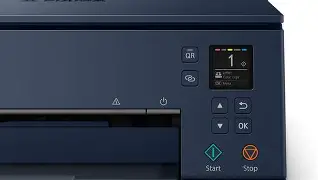
I also have to mention the auto-expandable output tray. Every time I hit print from my laptop in the other room, the motorized tray slides out automatically to catch the paper. It feels futuristic, but I’ve always been a little worried about the longevity of that motor. After a year, it’s still working fine, but I make sure not to leave anything in front of the printer that might block it. When you turn the printer off, it asks if you want to retract the tray. It’s a small detail, but I appreciate that the printer "packs itself away" when not in use.
The Cost of Ownership: An Honest Look at Ink
We need to talk about the elephant in the room: ink costs. In 2026, we are spoiled for choice with high-capacity tank printers, so why would anyone stick with cartridges? In my experience, it comes down to initial cost versus ongoing maintenance. If you print 500 pages a month, do not buy this printer. You will spend a fortune on ink. But for my lifestyle—where I might print ten documents one week and thirty photos the next, followed by two weeks of nothing—the TS6320 makes more sense.
What I found was that the XL cartridges are the only way to go. The standard "starter" cartridges that come in the box lasted me about three weeks. When I switched to the high-yield versions, I got significantly more mileage. I also noticed that the printer does a "cleaning cycle" if it hasn't been used in a while. This is a double-edged sword. It uses a bit of ink to prime the heads, which can be annoying, but it has prevented any clogs. I haven't had a single "streaky" print in the entire time I've owned it, even after leaving it sit for a month during a vacation. I’d rather lose a few milliliters of ink to a cleaning cycle than have to toss the whole unit because the print head dried out.
Pros and Cons after Long-Term Use
- Pro: Exceptional Photo Quality - The five-ink system truly punchs above its weight class for a home consumer printer. The color accuracy for skin tones and landscapes is excellent.
- Pro: Versatile Paper Handling - Having both a front cassette and a rear tray is a game-changer for people who switch between documents and photos frequently.
- Pro: Compact Aesthetics - It looks like a piece of modern hardware, not a clunky office machine. The LED status bar is genuinely useful.
- Pro: Solid Connectivity - Once configured properly, the wireless printing from smartphones and tablets has been flawless for me.
- Con: Expensive Ink Refills - Buying a full set of genuine Canon XL cartridges can sometimes cost nearly as much as a new entry-level printer.
- Con: Small On-Board Display - The 1.44-inch OLED screen is tiny. If you have any vision issues or hate navigating menus with a D-pad, this will be a point of frustration.
- Con: No ADF (Auto Document Feeder) - If you need to scan a 20-page document, you have to do it one sheet at a time on the flatbed. This is a massive "no" for heavy office use.
- Con: Plastic Build Quality - While it looks nice, the flaps and trays feel a bit flimsy. I always feel like I have to be gentle when loading the rear tray.
The Comparison: How It Stacks Up
To give you a better idea of where this sits in the market today, I’ve put together a table comparing it to other common types of printers I’ve used over the years. This should help you see why I chose the TS6320 over some "cheaper" or "better" alternatives.
| Feature | Pixma TS6320 | Typical Ink Tank Printer | Budget 2-Cartridge Printer |
|---|---|---|---|
| Initial Price | Mid-Range | High | Very Low |
| Photo Quality | High (5 Inks) | Variable (usually 4 Inks) | Low/Acceptable |
| Ink Cost per Page | Medium-High | Extremely Low | Very High |
| Space Footprint | Medium/Compact | Large | Small |
| Maintenance | Low (Self-Cleaning) | Medium (Potential Clogs) | High (Disposable Heads) |
Buying Guide: Is It Right for You in 2026?
If you are looking for a printer right now, you have to ask yourself what your "print profile" looks like. In my experience, people buy the wrong printer because they look at the purchase price rather than the usage style. Here is how I would break down the decision-making process for the TS6320.
The "Creative Hobbyist" Scenario
In this case, the TS6320 is a big win. If you enjoy scrapbooking, making your own greeting cards, or just like having physical copies of your smartphone photos, I’ve found this printer to be delightful. The ability to handle cardstock through the rear tray and the richness of the colors makes it a versatile tool for "light" crafting. I used it to print my own holiday cards last year, and everyone thought I had ordered them from a professional service.
The "Work From Home" Scenario
This is where it gets tricky. If your job involves scanning dozens of pages or printing 200-page reports every week, search elsewhere. The lack of an Automatic Document Feeder (ADF) was a major pain point for me when I had to scan my tax documents. Opening the lid for every single page is a chore that we should have left behind in 2010. Furthermore, the pigment black ink is great, but it’s not as economical as a laser printer for high-volume text. If you print mostly spreadsheets and memos, a black-and-white laser printer is a better companion.
The "Modern Student" Scenario
I think this is a solid middle ground for students. It doesn't take up much space on a desk, it prints great "presentation" graphics for school projects, and the mobile connectivity means you can print an essay directly from your phone as you’re walking out the door. Just be wary of the ink costs—I'd recommend keeping a spare black cartridge in your drawer so you don't run out at midnight before a deadline.
Discover deals on Electronics — updated daily.
Browse Now →The Technical Nuances: What I Noticed
One specific thing I noticed that isn't often mentioned is the "Ready Time." Some printers take forever to "warm up" before they actually start printing. The TS6320 is fairly quick to wake from sleep. However, I noticed that if it’s been off (not just in sleep mode) for more than a day, it goes through a rather loud initialization process that takes about 45 seconds. It clicks, hums, and whirs internally. It can be a bit startling if you aren't expecting it.
I also want to touch on the software again. While the mobile app is decent once connected, the desktop software suite feels a bit bloated. I eventually uninstalled the full Canon suite and just used the basic drivers. Windows and macOS are smart enough in 2026 to handle the printer without all the extra "photo organizing" software that manufacturers love to bundle. My experience became much smoother once I stripped it down to just the essentials.
In terms of durability, the scanner glass has held up well. I’ve scanned some old architectural photos that were a bit dusty, and the glass didn't scuff or scratch. The hinges on the scanner lid also have a "lift" feature, which I found was incredibly useful for scanning thick books or magazines. Instead of the lid sitting at an angle and letting light leak in, the hinge lifts up so the lid stays flat against the book. It’s a small engineering touch that makes a huge difference in scan quality.
Conclusion
After months of testing and hundreds of pages of varied output, my stance on the Canon Pixma TS6320 is nuanced. It is not a "perfect" printer, but it is an "honest" one. It doesn't pretend to be an office-grade powerhouse, nor does it claim to be the cheapest option on the shelf. In my experience, it fills a very specific niche: the user who values aesthetic design and high-quality photo output but doesn't print enough to justify the massive footprint and cost of an ink tank system.
What I found was that the TS6320 is a creature of balance. I was surprised by how much I actually enjoyed the process of printing photos at home again, something I had stopped doing because my previous printers made it such a hassle. The five-ink system is the star of the show here, providing a level of color depth that you just won't get from a standard budget printer. Yes, the ink is pricey, and yes, the screen is tiny, but the results speak for themselves when you see a high-gloss print come out of that motorized tray.
Ultimately, if you can find this model for a reasonable price in 2026, and you're aware of the trade-offs regarding ink costs and scanning, I think it remains one of the best "all-arounders" for a stylish home. It has outlasted two other printers in my circle of colleagues, and despite my initial skepticism about the motorized parts and the small screen, it has become a reliable part of my daily workflow. It’s a specialized tool for the person who cares about how their prints look, and for that person, it’s still a very compelling choice.